AI Killed Servant Leadership
From zero‑interest "peacetime" growth to AI‑accelerated "wartime" precision: how Active Leadership and AI‑first operating systems unlock profitable growth.
Read with...
Back in 2013, tech budgets felt limitless. VC cash flowed, middle‑manager ladders stretched ever upward, and “hire smart people, get out of their way” looked like genius. Fast‑forward to 2025: cheap money disappears, every headcount request is interrogated, and you (yes, you) now rely on an AI tool that costs pennies an hour but ships code, copy, and forecasts quickly.
AI isn’t just a tool; it’s a new social contract between leaders and teams
The deal: humans bring judgment, context, and purpose. AI brings fast throughput at low cost. The old servant‑leadership pact doesn’t fit this contract, and clinging to it quietly starves profitability.
The leadership model AI demands
I joined Anthony Enrico on the Leanscale podcast to unpack why AI didn’t just introduce new tools. It rewrote the leadership contract.
Watch the full conversation on YouTube.
The servant era: why it worked, until it didn’t
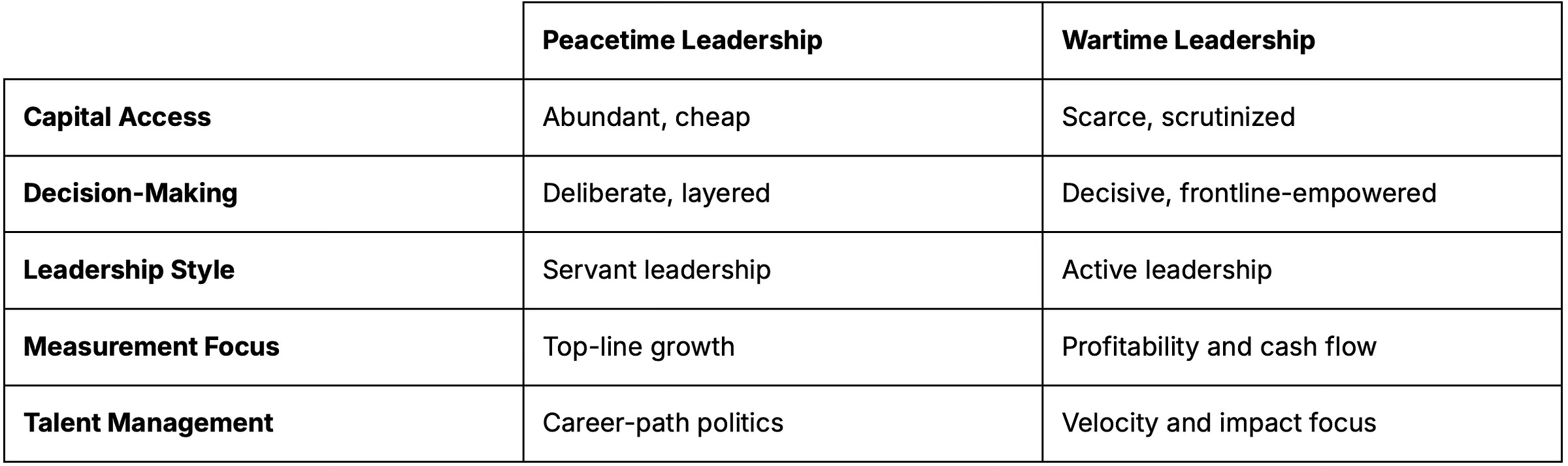
For a 12‑year bull run, capital was cheap and patience infinite. Servant leadership thrived:
- Distance from the work was fine, your talented hires would sort it out.
- Career-path politics gave ambitious managers something to climb.
- Delayed information loops mattered less when quarters closed red but funding rounds opened green.
That model began to crack when results needed to materialize this quarter, not in the next round deck. Building growth teams at GitLab gave me a front-row seat to a subtle leadership drift: the further leaders float from the frontline, the fuzzier their decision-making becomes, especially when precision matters most.
The catalyst: AI and capital discipline
Today, the North Star is profitability (EBITDA or Free Cashflow). Revenue‑per‑FTE remains a warning gauge, but only cash efficiency keeps companies breathing. At the same time, we’ve unleashed AI agents with zero career aspirations. You can’t mentor an LLM the way you mentor a person. You can only direct it, then prove its output ladders up to margin.
The result is a wartime tempo:
- Speed: ship value weekly, not quarterly.
- Precision: clarity drives profitable execution, vagueness drives inefficiency.
- Accountability: outcomes outweigh effort.
Active leadership defined
Lead from the front; no job too small.
Active Leadership rejects the serve‑and‑step‑back model in favour of earned credibility. Inspired by Matt McKinnis’ idea of being “micro‑interested,” the approach looks like this:
- Micro-interest, not micromanage. Dive deep where risk is high, then surface fast. Think of it as a trust but verify evolution, rooted in curiosity and precision rather than suspicion.
- Trust = consistency / time. Show up predictably and teams reciprocate. Deliver meaningful results sprint after sprint, and you'll earn the organization's confidence, and with it, bigger opportunities and increasingly critical initiatives.
- Context by doing. I personally trained our customGPT at VRIFY, the nuance I gained now accelerates every go-to-market decision.
Active leaders transform “distance from the work” into “velocity at the edge.” Rita McGrath captured it best: snow melts first at the edges. Those closest to the work hold the freshest ground truth. When paired with clear business context, their insights enable faster, more accurate decisions, giving organizations a decisive speed advantage.
Speed kills your competition. Lack of speed kills your business.
AI-first teams and the high-velocity OS
Behavioural foundation: rewriting reflexes
Before any system change sticks, individuals must rewire their default question set. So I ask every new team member to place a sticky note, square in their line of sight, that reads:
How can AI help me with what I'm about to do?
Seeing that prompt hundreds of times per week breaks legacy habits of "do‑it‑myself" execution and forms a new reflex: partner with AI first, then apply human judgment.
System foundation: the high-velocity OS
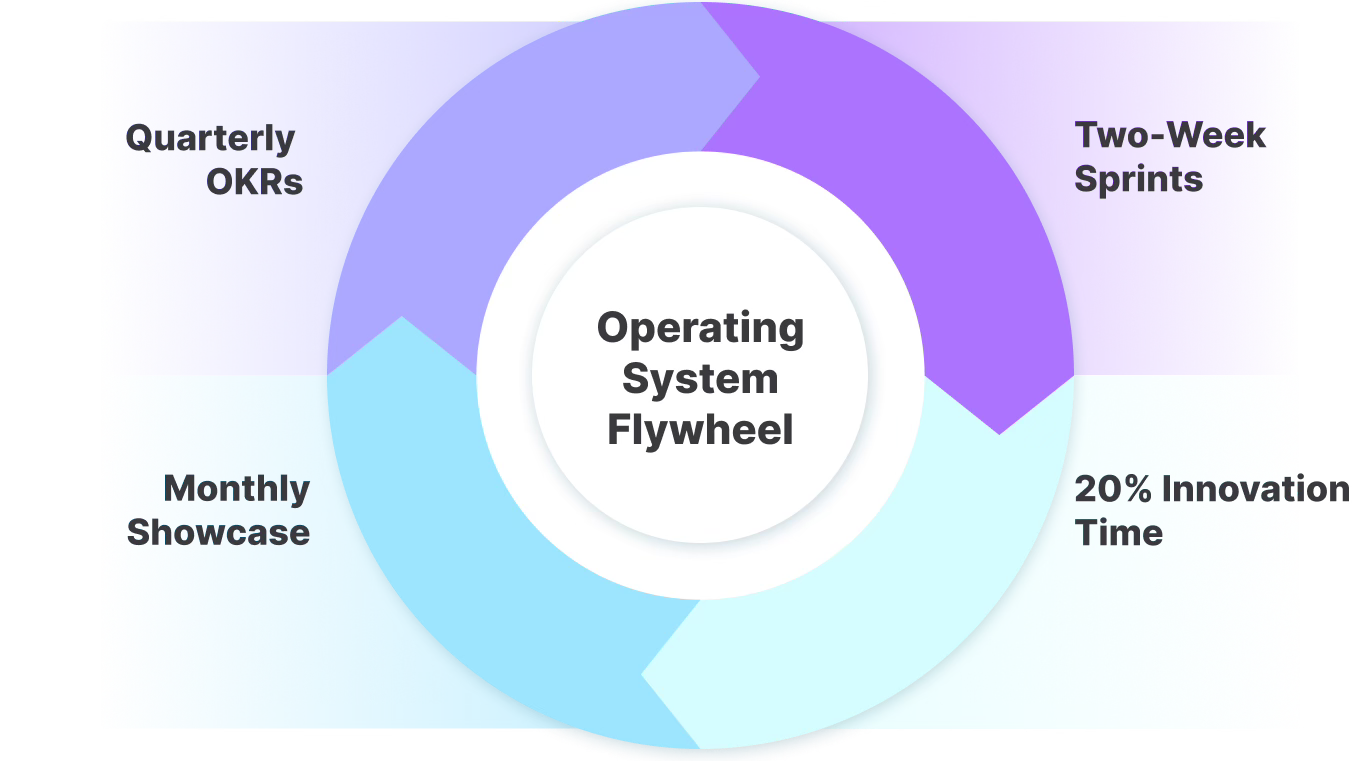
- Quarterly OKRs (3×3 Rule)
- Draft cross-functionally, share, then lock.
- Limit to 3 Objectives, each with up to 3 quantifiable Key Results.
- Reserve 20% slack for mission-critical interrupts.
- Two‑Week Sprint Cadence
- Monday plan, mid-sprint check, Thursday review and retro.
- Friday 20% Innovation Time, self-directed experiments become next quarter’s growth levers.
- Monthly Showcase
- Teams demo what shipped. Visibility breeds ownership and cross-pollinates ideas.
This operating system introduced predictable output and reduced cycle time, strengthening our ability to operate at high velocity, even while expanding headcount during a growth phase.
Operational precision toolkit
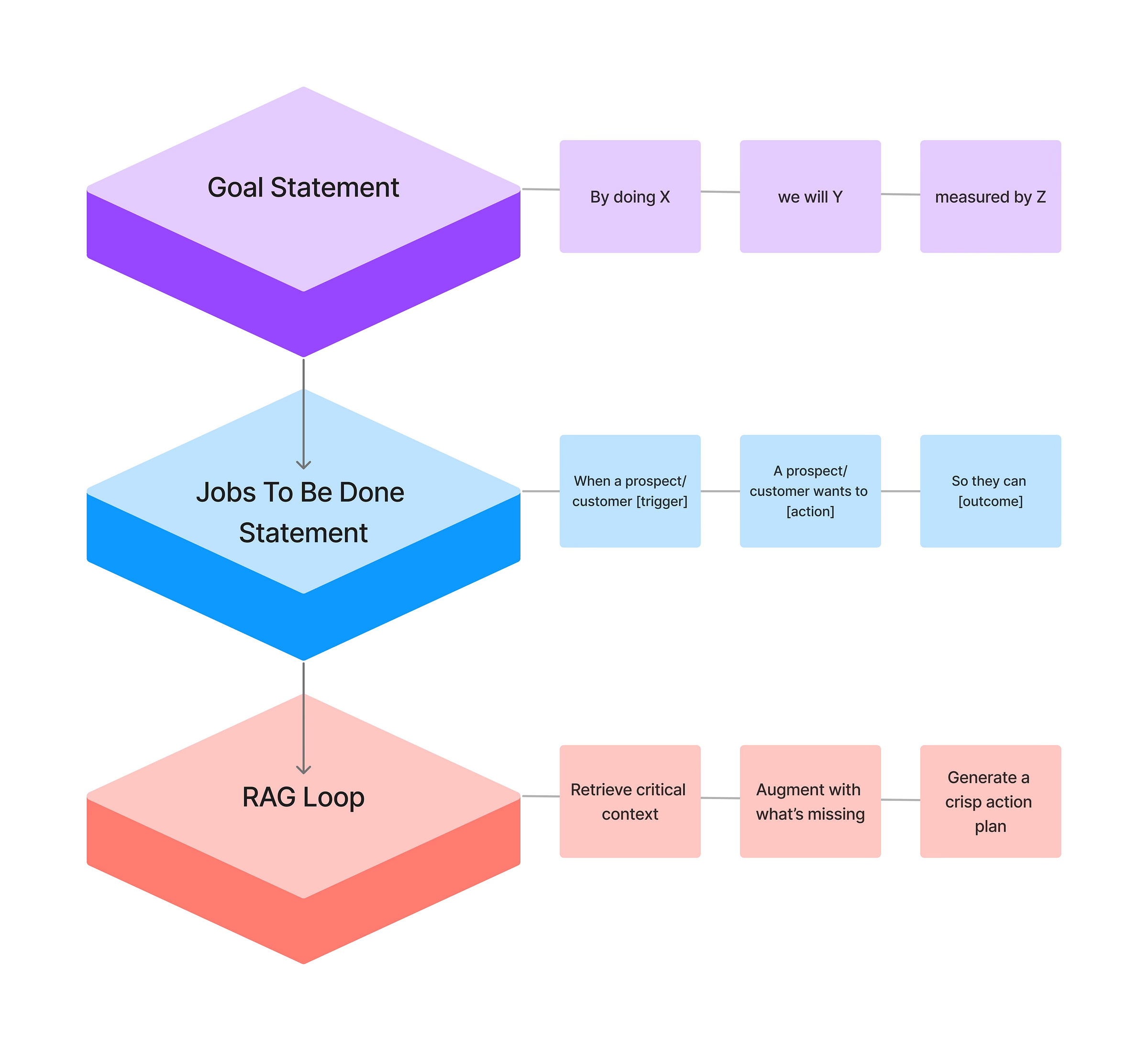
Words are force multipliers; imprecision is waste. Three tools keep language operational:
- Goal Statement
- By doing X, we will Y, as measured by Z.
- Jobs To Be Done Statement
- When a prospect/customer [trigger] ...
- A prospect/customer wants to [action] ...
- So they can [outcome] ...
- RAG Loop
- Retrieve critical context.
- Augment with what’s missing.
- Generate a crisp action plan.
- Publish a sub-1-page decision brief.
Together, they push the team to think scoreboard, not storyboard.
Putting it all together
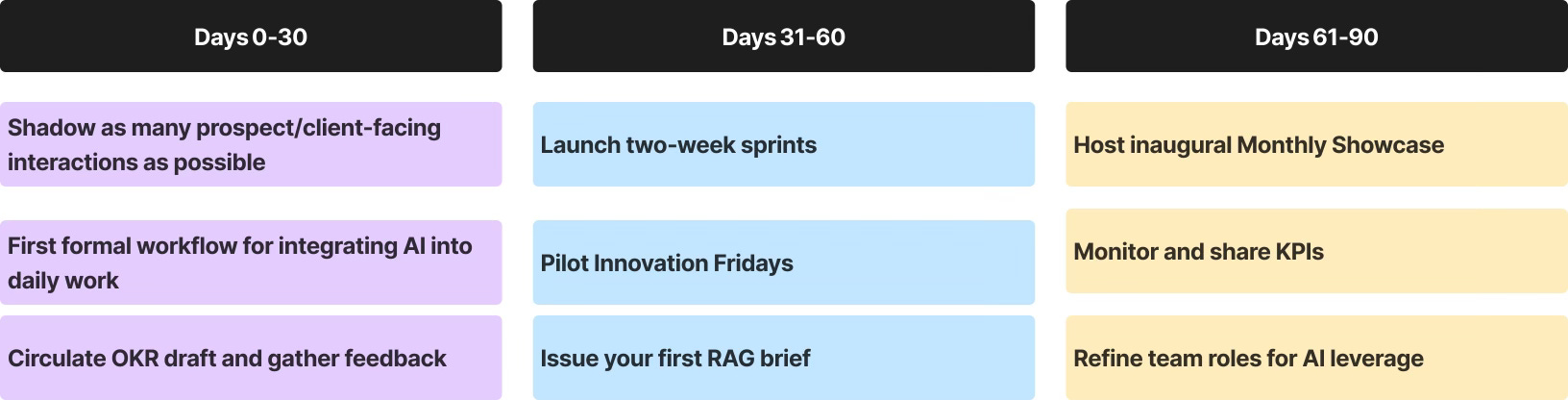
Adopt Active Leadership in 30‑60‑90 days:
- Days 0-30
- Shadow as many prospect/client-facing interactions as possible.
- Launch the first formal workflow for integrating AI into daily work.
- Circulate an OKR draft and gather feedback.
- Days 31-60
- Launch two-week sprints.
- Pilot Innovation Fridays.
- Issue your first RAG brief.
- Days 61-90
- Host the inaugural Monthly Showcase.
- Monitor and share KPIs.
- Refine team roles for AI leverage.
The reward: profitability climbs while morale follows, because clarity is the ultimate perk.
If you’re running a leadership off‑site, use this as the agenda: decide your 3×3 OKRs, lock the sprint cadence, and pick one RAG brief you’ll ship next week. Measure cycle time, revenue‑per‑FTE, and forecast accuracy, then iterate.
Decision support
Fast answers, zero fluff
The core framing, audience fit, and time commitment in under a minute.
01Why is classic servant leadership insufficient now?
I no longer think leader distance is enough. With AI making execution abundant, the constraint is directional clarity and judgment quality.
02What is Active Leadership in practice?
In practice, I run Active Leadership by setting priorities, decision rights, and escalation triggers up front, then reviewing outcomes on a tight cadence.
03Where should a team start on Monday?
On Monday, I start with a decision-rights audit on one critical workflow, set non-negotiable quality bars, and automate only repeatable steps.
04How do we use AI without lowering standards?
I use AI for draft velocity and option generation, but I keep human sign-off for customer commitments, risk calls, and irreversible decisions.
05How do we know the shift is working?
I know the shift is working when time-to-decision drops, rework declines, escalations decrease, and forecast confidence improves under pressure.