
Sales Motion & Team Structure
From proof to paid: a sales system that compounds
Timeframe
Aug 2024 to Aug 2025
Company
VRIFY
Role
VP Marketing
Read time
5 min
Read with...
- 01Stage framework with entry and exit gates plus required CRM fields
- 02Proof-led motion (proof → demo → win) tied to enablement, RevOps, and comp
- 03Forecast discipline with categories, weekly cadence, and scorecard
This is a deep dive in the VRIFY case study.
As VP Marketing, I partnered with Sales leadership, RevOps, and the proof team (Solutions and Geoscience) to make the proof-led motion enforceable in stages, handoffs, and coaching.
The loop: proof → demo → win.
When we tightened the GTM, Sales became the link between attention and ARR. The mandate was simple: run a proof‑led motion (proof → demo → win), make stage quality non‑negotiable, and build a team/comp system that rewards deals that advance with speed and discipline.
What changed: We made proof → demo → win the default arc, tightened stage gates and CRM hygiene, and aligned enablement, RevOps, and comp to reward clean progress.
1) Why we changed the motion (starting point)
-
Great event and ABM energy, inconsistent conversion beyond first meetings.
-
Stages existed, but entry/exit criteria varied by rep, forecasting was nonexistent.
-
Proofs (pilots/POCs) were powerful but not systematically sold or measured.
Strategic response
-
Normalize proof → demo → win as the universal arc.
-
Codify stage gates and CRM hygiene, coach to behaviour.
-
Align comp, enablement, and RevOps to the proof‑led motion.
2) Stage framework (definitions and gates)
Single source of truth lives in the Sales Stages one‑pager. Below is the narrative overview.
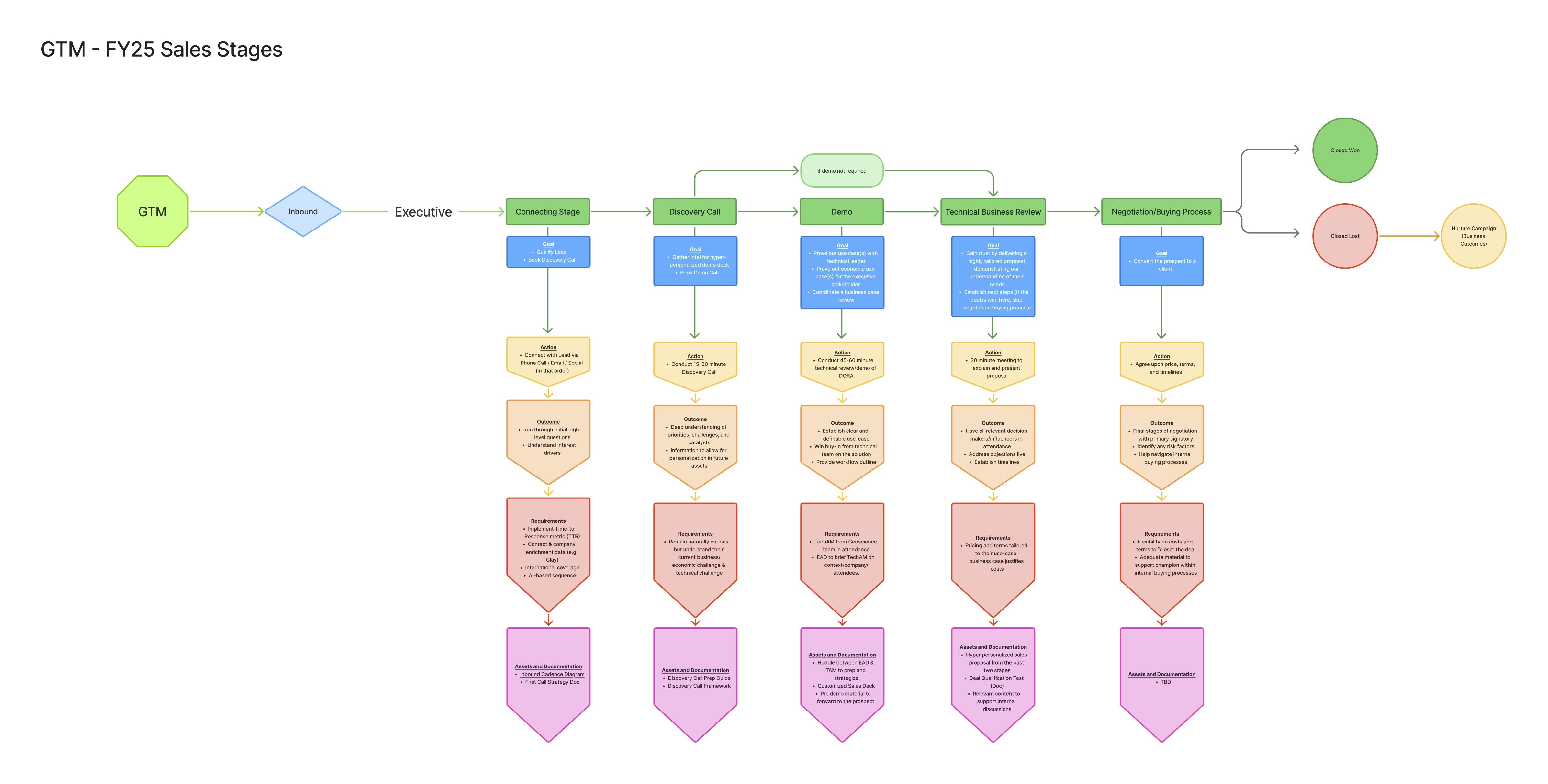
Inbound Qualified
Gate in: MQL/hand‑raiser matched to ICP & persona; SDR validation complete.
Gate out: Meeting held & discovery started; ownership transfers to AE.
Outbound Engaged
Gate in: SDR sequence yields positive engagement (reply/call) from target persona; clear problem statement or event intent.
Gate out: First meeting held; discovery notes captured.
Discovery (SQL)
Gate in: First AE meeting (optionally Solutions/GeoSci); problem, impact, and roles identified; next meeting set.
Gate out: Fit confirmed, stakeholders mapped, and proof path proposed (or exit to nurture).
Solution Fit
Gate in: Use‑case mapped to DORA/Viz; data availability and technical prerequisites confirmed.
Gate out: Mutual Action Plan agreed incl. proof scope, success criteria, timeline, and owners.
Proof / Pilot (SAO)
Gate in: Commercial & technical terms agreed; access and datasets provisioned.
Gate out: Success criteria met; exec sponsor debrief; pricing & terms drafted (or learn/exit).
Business Case
Gate in: Value quantified (before/after, risk/return); references queued; security/legal review started.
Gate out: Verbal yes; paper process underway.
Commit
Gate in: Mutual close plan aligned; blockers removed; CFO/legal looped.
Gate out: Signed (Closed Won) or documented reason (Closed Lost).
CRM hygiene (required fields per stage)
-
Must‑haves: Primary contact, role, problem statement, next step & date, value hypothesis. Proof success criteria when in Pilot.
-
Auto‑checks: Close date recency, stage duration, next step missing, amount vs ACV guardrails.
3) Qualification pattern (lightweight, coachable)
-
Problem & Impact: What hurts and why now?
-
Stakeholders: Who decides, who uses, who blocks?
-
Data & Readiness: What datasets are available, technical prerequisites met?
-
Money & Motion: Budget path, procurement/legal/security steps, target close date aligned to program timeline.
4) Orchestration and SLAs
-
SDR → AE: Same‑day handoff on Tier‑1, 24h on others, notes template enforced.
-
AE → Proof Team (Solutions/GeoSci): Proof brief template, kickoff within 14 days of commit.
-
Exec Sponsor: Assigned for Tier‑1 at Discovery, joins debrief after proof.
5) Enablement (make quality the default)
-
Talk tracks: CEO and VP Exploration variants, objection handlers (data readiness, change cost, timelines).
-
Demo scripts: 90‑second story + deep‑dive path, data‑to‑decision walk‑through.
-
Proof kit: Mutual Action Plan templates, success criteria library, sample datasets, debrief template.
-
Value tools: ROI/impact calculator, before/after narratives, customer proof sheets.
6) Territories, routing, and team model
-
Model: SDR (inbound & Tier‑1/2 outbound), AE (new ARR), CSM (post‑sale, assists proof setup), Solutions/GeoSci (proof delivery).
-
Routing: Tier‑1 named, Tier‑2 pooled by region/commodity, Tier‑3 inbound only.
-
Escalation: Exec sponsor for top accounts, founder path for strategic logos.
7) Compensation principles (aligned to proof-led growth)
-
Pay for ARR with accelerators (quota $2.25M USD): Variable comp tied to Net New ARR with accelerators at 110%/125%/150% attainment. Target effective commission ~4.7% of ARR at 100% (range ~4.5 to 5.6% across 80 to 150%). Transactional credit for 6‑month DORA pilots. SPIFFs for Tier‑1 meetings that progress to qualified proofs. Kicker on proof → win.
-
Quality & policy guardrails: Credit follows stage exit criteria. Stage reversion reduces credit. Discounting outside approved bands requires approval. Currency handling: base in CAD, quota in USD (FX applied per plan).
8) Forecast discipline
-
Categories: Pipeline / Best Case / Commit mapped to stage + exit criteria confidence.
-
Cadence: Weekly forecast call, roll‑up by AE → Manager → SLT, risk log & upside tracked.
-
Analytics: Stage duration, stuck deals, forecast vs actual, next‑step compliance.
9) Metrics
-
Conversion: Framework defined, baselining in progress (Inquiry→meeting, meeting→SQL, SQL→pilot/proof, opp→win).
-
Velocity: Framework defined, baselining in progress (time‑to‑first‑meeting, demo→pilot/proof days, cycle days).
-
Quality: Framework defined, baselining in progress (forecast accuracy, stage reversion rate, notes compliance).
-
Pricing & packaging: Rollout completed, early signal shows improved win rate and deal velocity.
10) What changed
Results
- Conversion: meeting→SQL 65%; proof→demo 60%; opp→win 80% (+30 pp).
- Velocity: cycle days ↓ 25 days; time-to-first-meeting 30 days.
- Forecast: accuracy 80%.
- Shared language and gates reduced variance, deals advanced faster with fewer surprises.
- Proof became a managed program, not an accident, which raised win rates and confidence among buyers.
- Forecasts came into view, coaching focused on specific gaps visible in the scorecard.
Decision support
FAQ: Fast answers, no filler
The objective, outcomes, and next best path in under a minute.
01What is VRIFY Sales Motion & Team Structure?
A deep dive on stage gates, proof delivery, and forecast discipline that made proof → demo → win enforceable.
02What problem did the sales system solve?
Deals advanced without consistent proof or stage hygiene. The system made proof a managed program with clear entry/exit gates and coaching cadence.
03What was built in the sales motion?
A Sales stage framework with entry and exit criteria, proof as a managed program, and a weekly coaching cadence tied to the scorecard.
04What results are documented?
Meeting→SQL reached 65%, proof→demo reached 60%, opp→win reached 80% (+30 pp), cycle days decreased by 25 days, and forecast accuracy reached 80%.
05Who is this approach for?
Best for complex B2B sales where proof and stage discipline drive conversion quality. Less useful for simple, self-serve transactions.