Strategy & Company Alignment
Operating System for GTM
Timeframe
Aug 2024 to Aug 2025
Company
VRIFY
Role
VP Marketing
Read time
4 min
Read with...
- 01Category positioning, proof loop, and shared GTM scorecard
- 02Company cadence: quarterly OKRs, monthly health reviews, two week sprints
- 03Decision rights with DRIs, stage gates, and clean handoffs
This is a deep dive in the VRIFY case study.
When I arrived at VRIFY, the work across Marketing, Sales, Product, and Geoscience was energetic but fragmented. Initiatives weren’t connected to shared choices, shared cadences, or a shared scoreboard.
We had attention from Tier‑1 explorers, promising tech (DORA for AI‑assisted discovery, Viz for interactive 3D presentations), and major event moments on the calendar. What we lacked was a single operating system: shared choices, shared cadences, and a shared scoreboard that turned that energy into compounding results. This is how we built it.
As VP Marketing, I co-created the corporate and GTM strategy, then built the cadence, decision rights, and scoreboard that made it runnable.
What changed: We named the category, made proof the default loop, and put OKRs plus one scorecard under clear DRIs and stage gates.
Diagnosis and strategic choices
The starting point
- High intent around events, inconsistent follow‑through.
- Site and lifecycle pulling in different directions, unclear handoffs.
- Sales stages existed, but entry/exit criteria and forecast discipline were uneven.
The choices
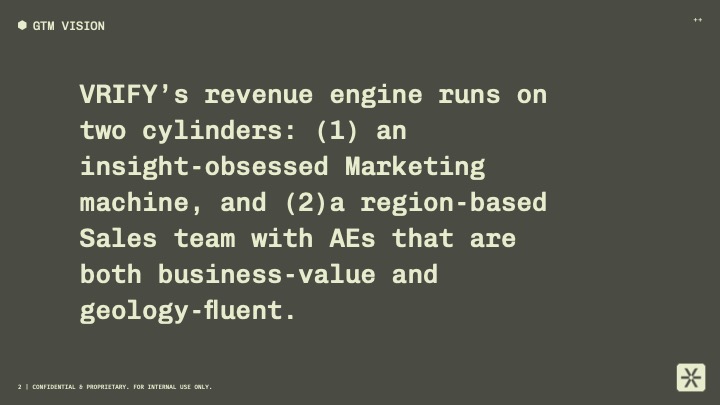
- Name the game: Lead the “AI‑assisted mineral discovery” category, anchored on “AI in the hands of geoscientists.”
- Make proof the center: Run proof → demo → win as the universal loop.
- Focus the go‑to‑market: ABM + events as the spine. Content‑first, with Digital Experience as the through‑path.
- Unify the funnel: A To / Through / In motion with shared definitions and metrics.
- Instrument the business: Quarterly OKRs and one scorecard everyone trusts.
Operating system
Cadence
- Quarterly: Company & GTM OKRs, investment bets, capacity planning.
- Monthly: Pipeline health review (coverage, velocity, stage conversion), ABM tier coverage, forecast and upside, board and exec updates on category, demand, and pipeline.
- Two Week Sprints: GTM scorecard, top risks/unblockers, experiment reviews, event follow‑ups.
Org & decision rights
- Marketing: Brand, ABM, Content, Digital Experience (website/AEO/GEO/SEO/CRO), Lifecycle, Events.
- Sales: Account Executive / Solutions Architect model, enablement, territories, comp that rewards proof and ARR.
- CS/Proof: CSM + Geoscience partnership to run pilots/POCs and generate referenceable proof.
- Product: PM + TPMM alignment so launches, narrative, and feature value land coherently.
- Decision rights: Named DRIs and stage gates, entry/exit criteria apply across teams.
Unified To / Through / In
- To (Demand): ABM plays, field events, thought leadership and social. KPIs: meetings, cost/meeting, Tier‑1/2 coverage.
- Through (Digital Experience & Lifecycle): Site speed/AEO/GEO/SEO/CRO, personalized nurture. KPIs: sessions, demo rate, demo quality.
- In (Product‑led & Sales): Pilot/proof management, stage discipline. KPIs: proof → demo %, proof win rate, cycle days, opp → win %.
Scorecard (single source of truth)
- Demand: Sessions, demo requests, cost/meeting.
- ABM: Tier‑1/2 coverage %, meetings/account, pipeline by tier, meeting → SQL conversion.
- Sales: Stage conversion, cycle days, opp → win %, forecast accuracy.
- Efficiency: CAC payback, Gross Sales Efficiency, NRR/GRR.
Operating artifacts (what we used and shipped)
- OKRs: Quarterly GTM & Marketing objectives and key results.
- Playbooks: ABM personas, tiering rules, channel cadences, event runbooks.
- Sales: Stage definitions with entry/exit criteria, enablement packs, comp overview.
- Narrative: Category story, product one‑pagers (DORA, Viz), proof library (customer success stories).
Execution timeline (example arc)
- Q1: Category narrative, ABM tiering, sales stages v1, DX speed/AEO/GEO/SEO fixes.
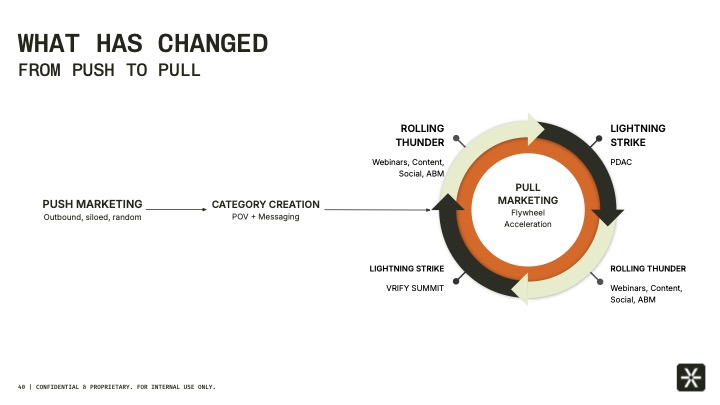
- Q2: PDAC launch, lifecycle personalization, ABM activation around field events.
- Q3: Proof pipeline scale, forecast discipline, comp tune, partner activation.
- Q4: Expansion motion, category PR, refine CAC payback & GSE.
What changed (alignment to outcomes)
- One language for value creation (category → proof → demo → win).
- One cadence that compounds learning (OKRs + scorecard).
- One funnel with clean handoffs (To / Through / In).
- Better focus (Tier‑1/2 accounts) and better forecast discipline.
Outcomes
Results
- Demand: sessions ↑ 1200%, demo rate (meeting→demo) ↑ +25%.
- ABM: 20% of new pipeline sourced by ABM programs.
- Sales: proof → demo 60%, demo win rate 80%, cycle days ↓ 25 days, opp → win ↑ +30 pp, forecast accuracy 80%.
- Team build & onboarding: 10 critical hires, new‑hire ramp time ↓ 40%.
- Efficiency: CAC payback ~2.5 months, GSE ~1.9×, NRR/GRR (Confidential).
Decision support
FAQ: Fast answers, no filler
The objective, outcomes, and next best path in under a minute.
01What is VRIFY Strategy & Company Alignment?
A deep dive on the operating system that kept teams aligned: category positioning, proof-led cadence, OKRs, one scorecard, and clear decision rights.
02What problem did alignment solve?
Teams executed in parallel without a shared constraint. The system unified the category, proof loop, and cadence so marketing, sales, and product pulled in the same direction.
03What was built in the alignment system?
Quarterly OKRs, monthly health reviews, two-week sprints, plus DRIs and stage gates that protected focus and throughput.
04What results are documented?
Sessions increased 1200% and demo rate (meeting→demo) increased +25%. ABM sourced 20% of new pipeline, cycle days decreased by 25 days, and new-hire ramp time decreased by 40%.
05Who is this approach for?
Best for cross-functional GTM teams with multiple handoffs and a proof-heavy sales motion. Less useful for single-team execution with minimal dependencies.