
Product Launches
Preparing Blaxel's OpenAI Agents API launch: a technical article draft, runnable example, channel-specific social copy, visuals and release requirements.
Timeframe
Joined June 2026
Company
Blaxel
Role
Head of Growth & Marketing
Read time
2 min
Read with...
- 01Wrote the OpenAI Agents API launch article draft and supporting social package
- 02Connected the launch explanation to a runnable file-persistence example
- 03Specified each asset's visual, destination, link and approval requirements
Make the integration concrete
For Blaxel's OpenAI Agents API launch, I wrote the article draft and supporting company, founder and engineering social copy. My job was to make Blaxel's role clear and give a developer something useful to try after reading the announcement.
The explanation centred on a concrete task: give an agent a computer, let it produce a file, and show how that file could remain useful after the session ended. OpenAI managed the agent session. A Blaxel Sandbox ran the work. Agent Drive could keep the files available for a later run.
That distinction shaped the writing and its connection to the OpenAI Agents API cookbook. The draft explained the integration; the cookbook gave readers a way to inspect it.
Show what survives the next run
The persistence claim needed a clear boundary. Agent Drive could retain files, including reports, notes and tool output. It didn't automatically transfer a live OpenAI session or conversation to the next agent.
The cookbook's optional handoff makes that distinction visible. One agent writes summary.md. The first session and Sandbox are deleted. A fresh pair then reads the saved file and writes review.md.
OpenAI Agents API + Blaxel Agent Drive
A report carried into a fresh agent session
Follow the cookbook's optional file handoff.
The first agent creates a report
OpenAI session
Blaxel Sandbox
Read the source file and write summary.md.
Writes the report
Persistent files
Agent Drive
summary.md
Saved files stay available to the next run.
The cookbook checks that summary.md contains an exact marker copied from the source file.
./run.sh --handoffThe example checks the contents as well as the file's existence: the report must carry a marker from its source, and the review must carry that original marker plus a new handoff marker. That gives a developer something specific to verify. The README also states the access prerequisites, including Agent Drive for the handoff.
Adapt the story to the person sharing it
The social package gave each author a different way into the integration. The company draft introduced the product connection and pointed to the cookbook. The founder draft explained why an agent system needed compute, storage and networking. The engineering draft followed the session connection and the separate lifecycle of the files.
The underlying claim stayed consistent. The entry point, level of detail and planned visual changed with the person sharing it.
Launch social / Working draft
Three ways into the same launch
Company / X launch thread
OpenAI built the harness. Blaxel gives it a computer.
OpenAI manages the session, tools, approvals, and turns. The executor connects outbound from a Blaxel Sandbox, so the sandbox needs no inbound port.
Agent Drive keeps files available after temporary compute is cleaned up. Another sandbox can pick up the report, tool output, dependency cache, or notes in a later run.
- Planned visual
- Approved launch visual or architecture diagram
- Destination
- Launch article or cookbook
- Before release
- OpenAI approval and a public cookbook
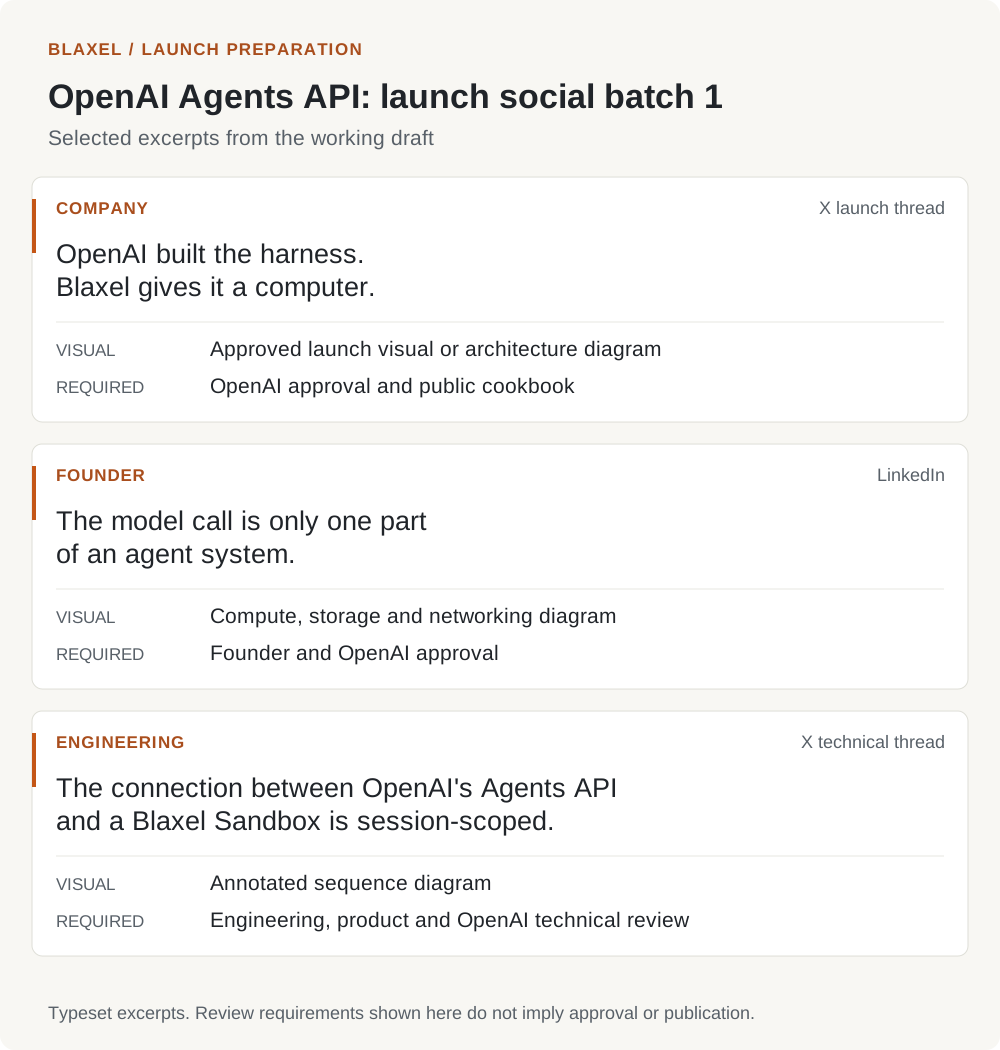
I specified the visual, destination and approval requirements alongside the copy. For the company LinkedIn version, for example, the brief called for a short demo showing the session, sandbox execution and resulting artifact. That piece depended on an approved demo, public cookbook and approved OpenAI wording. Those dependencies were part of the release preparation.
My part in the launch
My contribution was the article draft, supporting social copy and release preparation. The article Blaxel published carries Michael Stolarz's byline. I link it as the published launch reference, separately from my draft work.
I used the same approach in the customer-story program: write the product explanation, connect it to an example a developer can inspect, and prepare the copy and visuals for the people who would share it.
FAQ
Questions this page answers
01What did Michael Preuss do for Blaxel's OpenAI Agents API launch?
I wrote Blaxel's launch article draft and supporting company, founder and engineering social copy. I connected the explanation to the cookbook and specified the visual, link, destination and approval requirements for each piece.
02How did the Blaxel launch writing explain the integration?
The Blaxel draft explained how OpenAI managed the agent session, a Blaxel Sandbox ran the work and Agent Drive kept files available across runs. It distinguished retained files from a live session or conversation, then directed developers to a cookbook with explicit access prerequisites.
03What did the Blaxel launch cookbook demonstrate?
In Blaxel's documented cookbook handoff, one agent writes summary.md. The script deletes that agent's OpenAI session and Blaxel Sandbox, then starts a fresh pair that reads the saved file and writes review.md. It checks source and handoff markers in the files. This path requires Agent Drive access.
04Did Michael Preuss write the final published Blaxel launch article?
My documented contribution to Blaxel's launch was the article draft, supporting social copy and release preparation. The final published article carries Michael Stolarz's byline and is linked separately as the published launch reference.