
AI Marketing Systems
The marketing tools I built at Blaxel: paid media review, market research, answer-engine citation analysis and a shared go-to-market knowledge graph.
Timeframe
Joined June 2026
Company
Blaxel
Role
Head of Growth & Marketing
Read time
2 min
Read with...
- 01Built AI-agent workflows that moved paid media review from monthly to daily
- 02Built tools for market research and answer-engine citation analysis
- 03Created shared go-to-market context with evidence and review rules
Build tools around the recurring work
As Blaxel's first marketing hire, I owned the strategy and budget while also doing the work. I built tools for the recurring reviews: what was happening in paid acquisition, what was changing in the market, and which sources were shaping answers about the category.
Each tool had a specific input and a decision to support. Paid review brought together delivery and product outcomes. Market research connected a market read to its sources. Answer-engine citation analysis helped identify conversations worth reviewing.
Review paid performance daily
The paid-growth system combined Google Ads delivery, PostHog product activity and Stripe payment outcomes. AI-agent workflows synthesized conversion data and queued proposed optimization changes, moving review from monthly to daily.
I kept campaign changes behind human approval. A proposed change had to pass validation, match the approved change set and have a rollback or compensating action. Low-volume evidence remained inconclusive.
Paid growth / Review workflow
From paid signals to proposed changes
Monthly → Daily
Delivery
Google Ads
Spend, clicks and ad conversions
Product
PostHog
Product activity and conversion behaviour
Payments
Stripe
Payment outcomes
AI synthesis
Findings + proposed changes
Bring the evidence into review. Keep low-volume findings inconclusive.
Human decision
Approval before campaign changes
Validation, a valid approval matching the change set, and a rollback or compensating action.
That made the automation useful for preparation and review while keeping responsibility for spend explicit. The paid-growth page covers the program's results and measurement boundaries.
Make market research traceable
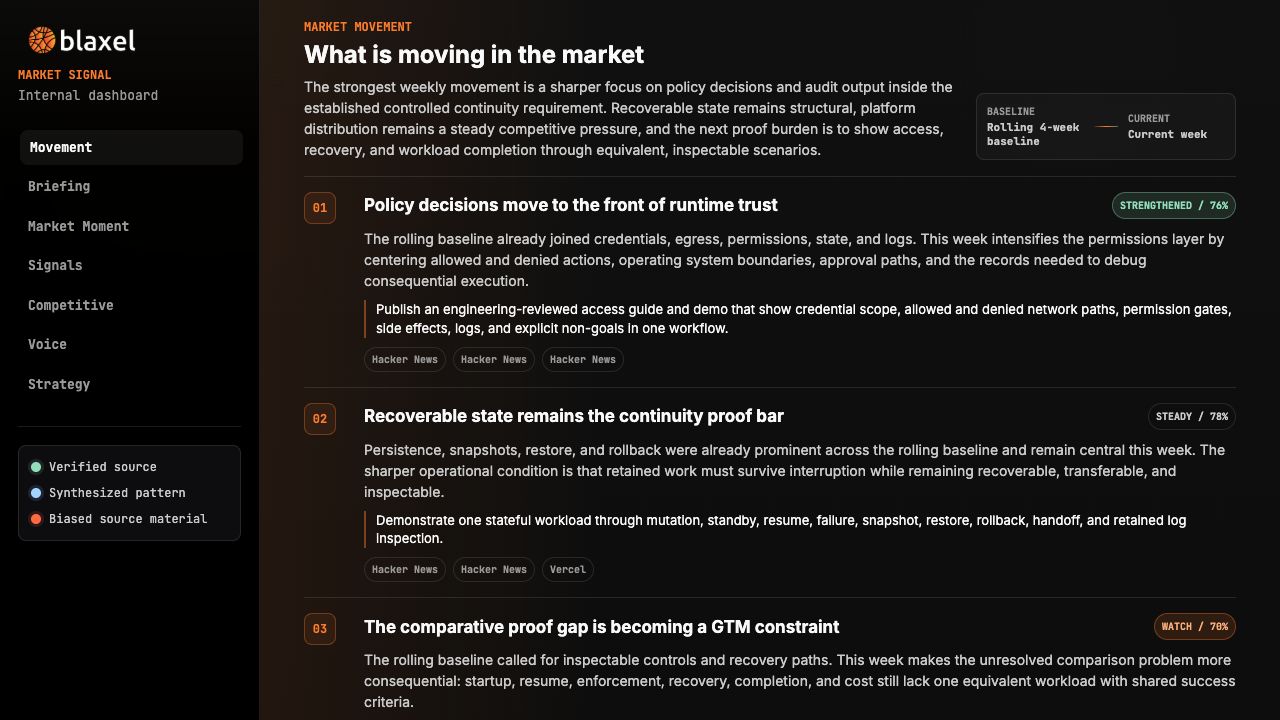
The Market Signal dashboard kept each assessment linked to its sources. The workflow collected and scored material, then checked the sources behind the claims before including them in the dashboard.
Find the conversations behind AI answers
I also built a citation-review tool around Profound's answer-engine data. It identified Reddit conversations for review using three signals: frequently cited threads, topics where Blaxel was less visible and threads gaining citation share.
The tool turned those signals into a weekly queue. It helped direct attention to the source material influencing answers, with human review before any participation. It didn't automatically post into the conversations.
Community Citation Radar / Queue design
Three signals shape the weekly queue
Profound citation data, with Reddit thread context.
Highest cited
Up to 3 review slots
What already shapes the answers?
Threads with strong citation activity in the category.
Underrepresented
Up to 3 review slots
Where is Blaxel less visible?
Cited conversations in topics with a visibility or representation gap.
Newly climbing
Up to 3 review slots
What is gaining attention?
Threads gaining citation share across the latest complete week.
9 threads at most
One weekly review queue
Each selected thread appears once. Read the source and decide whether there's a useful contribution to make.
Participation stays human-reviewed.
This was part of the answer engine optimization work: understand what the engines were citing, inspect the source and decide whether there was a useful contribution to make.
Give the tools shared context
The go-to-market (GTM) knowledge graph held positioning, customer context, messaging, proof and writing guidance in versioned files. It distinguished source-backed claims from inferences and drafts, with review rules for deciding what was ready to use.
That gave the work a common reference. A launch draft, a paid review and a positioning decision could draw on the same product and customer context while preserving the evidence each task needed.
FAQ
Questions this page answers
01What marketing tools did Michael Preuss build at Blaxel?
I built Blaxel tools for paid media review, market research and answer-engine citation analysis, supported by a shared go-to-market knowledge graph. Each tool brought evidence into a specific marketing review or decision.
02How did Blaxel's paid-review automation work?
Blaxel's paid-growth system combined Google Ads delivery, PostHog product activity and Stripe payment outcomes. AI-agent workflows synthesized conversion data and queued changes for human approval. Campaign changes required validation, a matching approval and a rollback or compensating action.
03How did Michael Preuss use answer-engine citation data at Blaxel?
At Blaxel, I built a tool that used Profound citation data to identify Reddit conversations worth reviewing. Its weekly queue considered frequently cited threads, topics where Blaxel was less visible and threads gaining citation share. Participation remained human-reviewed.
04What changed in Blaxel's marketing review cadence?
My AI-agent workflows moved Blaxel's paid media review from monthly to daily. The market and citation tools produced research inputs for review; no separate revenue or answer-engine visibility lift is assigned to those tools.