
Unified Funnel Conversion Lift
Unified funnel definition, UX improvements, and instrumentation
Timeframe
Jun 2020 to Aug 2024
Company
GitLab
Role
Senior Manager, then Director, Integrated Growth and Inbound Marketing
Read time
2 min
Read with...
- 01Unified PLG and sales-assisted funnel definitions
- 02Shipped UX improvements and instrumentation at priority conversion points
- 03A single, measurable funnel definition across the path, with agreed stage boundaries
This deep dive covers one slice of my GitLab role as Director, Integrated Growth and Inbound Marketing: we stopped treating channels as the unit of work, unified the journey into one measurable funnel, then improved conversion without relying on higher spend.
Problem: fragmented journey and definitions
The journey from awareness to product action was fragmented across PLG and sales-assisted paths. We had activity, but not a shared map, consistent stage boundaries, or a short list of conversion moments everyone could align around.
Funnel definition and evidence
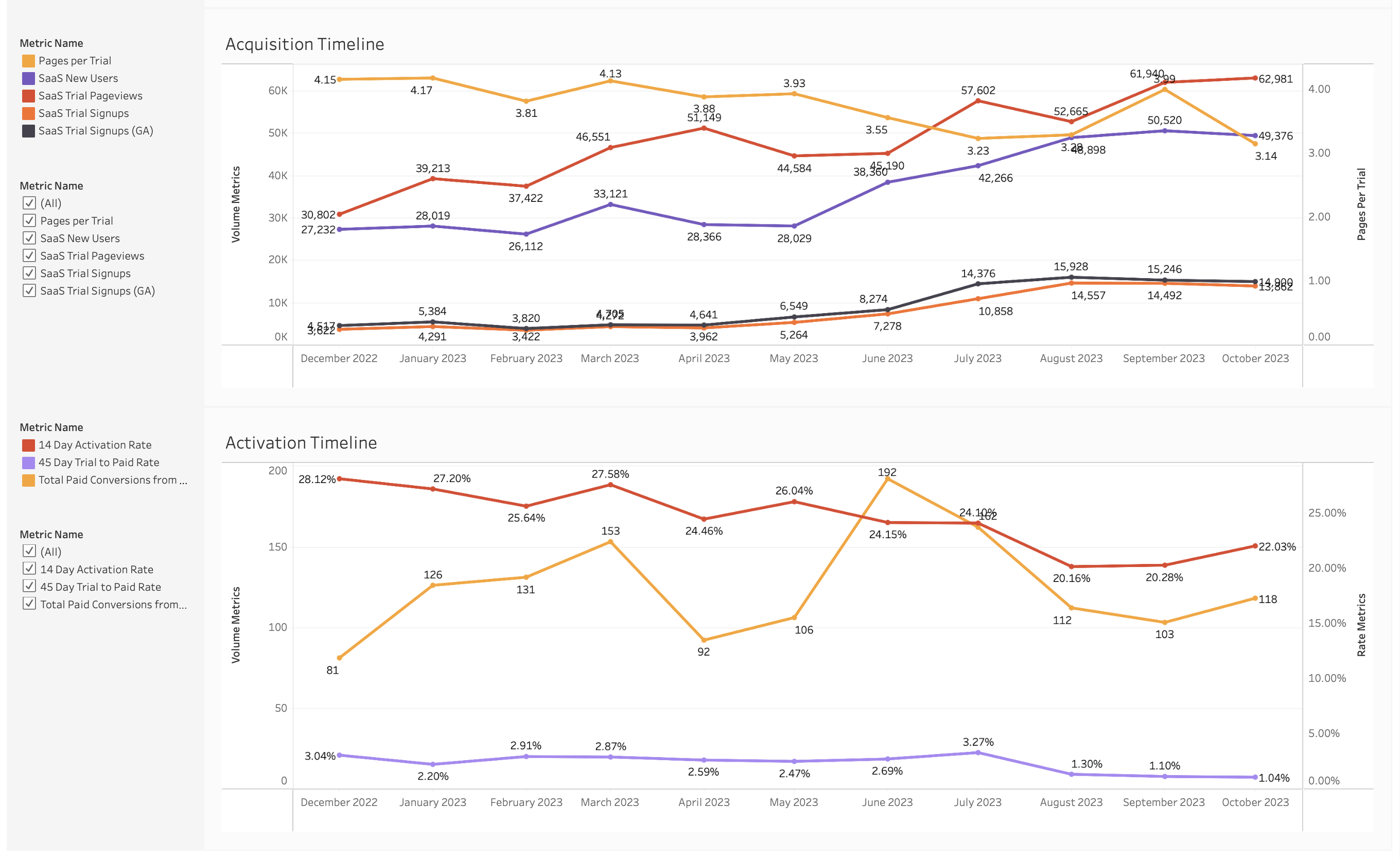
Funnel view
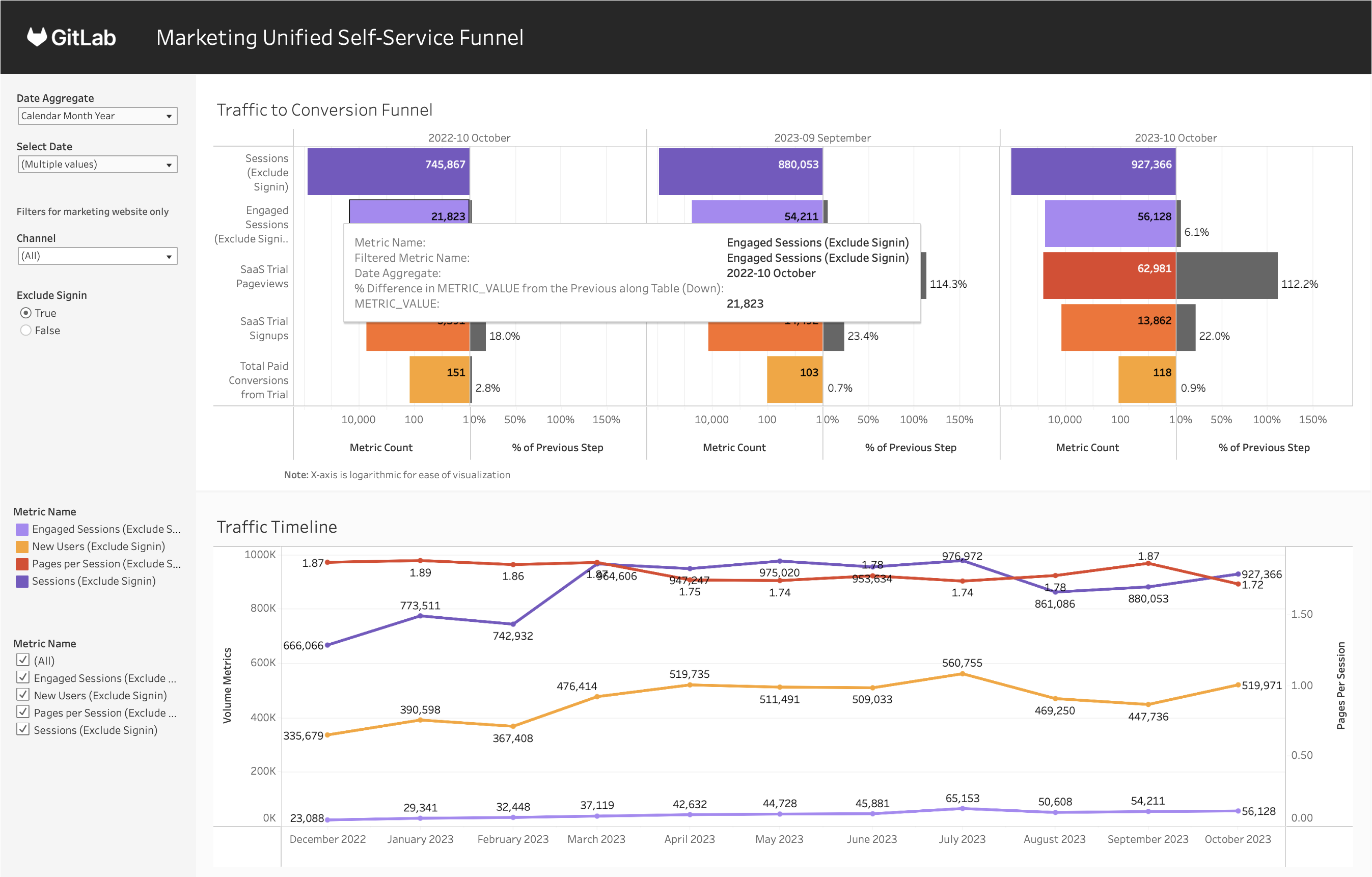
Acquisition and activation over time
Shift: the journey is the unit of work
Stop treating channels as the unit of work. Treat the journey as the unit of work.
Two moves:
- A single, measurable funnel definition across the path, with agreed stage boundaries.
- A short list of priority conversion moments, with DRIs and an experiment cadence tied to downstream activation.
What I did: map, ship, instrument, iterate
-
Mapped the end-to-end journey and aligned stakeholders on definitions and the highest-leverage conversion points.
-
Shipped UX and journey improvements at the priority conversion moments, the goal was less friction and clearer next steps.
-
Instrumented key steps so we could isolate what changed and why.
-
Established an experiment cadence so learnings compounded instead of resetting each quarter.
Example: Marketing site redesign
This is a good example of the “win with tradeoff” pattern. We shipped a redesign that improved downstream quality, even when some top-of-funnel engagement metrics moved the wrong way.
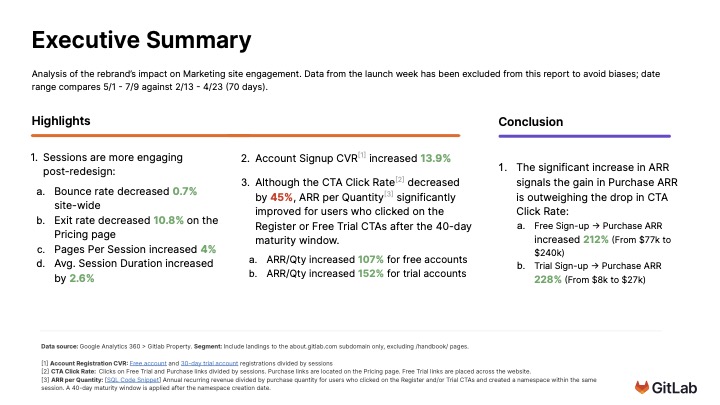
Results: trial conversion and sign-ups
These outcomes were tracked in our unified funnel reporting and quarterly reviews.
- Trial conversion: +40%.
- Account sign-ups: +22%.
Tradeoffs
We traded breadth for depth. Fewer parallel initiatives, more focus on the handful of conversion points that mattered.
Decision support
FAQ: Fast answers, no filler
The objective, outcomes, and next best path in under a minute.
01What is Unified Funnel Conversion Lift?
A GitLab deep dive on unifying a fragmented journey into one measurable funnel, then improving conversion through UX, instrumentation, and an experiment cadence.
02What problem did this work solve?
The journey was fragmented and stage definitions varied across teams, so conversion work did not compound. This work unified the funnel and made UX and instrumentation a repeatable loop.
03What was built in the unified funnel?
An end-to-end journey map, aligned stage definitions, instrumentation at priority conversion steps, and an experiment cadence so learnings compounded.
04What was the core shift?
Stop treating channels as the unit of work. Treat the journey as the unit of work.
05What results are documented?
Trial conversion increased 40%. Account sign-ups increased 22%.
06Who is this approach for?
Best for PLG plus sales-assisted funnels with multiple handoffs and shared stage definitions. Less useful when conversion is owned by one team and one surface.
07Where can I go deeper next?
Go back to the parent case: GitLab. For the inbound recovery loop, read Increase Quality Site Traffic. Next, read Shaping GitLab’s Integrated Growth and Inbound Marketing Team.