
GitLab
Rebuilding integrated growth and inbound
Timeframe
Jun 2020 to Aug 2024
Company
GitLab
Role
Senior Manager, then Director, Integrated Growth and Inbound Marketing
Read time
3 min
Read with...
- 01Rebuilt inbound and integrated growth as an operating unit with quarterly planning and a scorecard
- 02Reversed a marketing site traffic decline with cross-functional execution
- 03Shipped a unified To/Through/In PLG motion across core teams
Scope: integrated growth and inbound
From June 2020 to February 2022, I was Senior Manager of Integrated Growth and Inbound Marketing at GitLab. From February 2022 to August 2024, I was Director of Integrated Growth and Inbound Marketing. Across both roles, my charter was to rebuild inbound and integrated growth as an operating unit, reverse a marketing site traffic decline, and tighten the conversion and lifecycle loop across the funnel.
Most of the work wasn’t channel optimisation. It was alignment, ownership, and instrumentation.
I treated inbound and integrated growth as an operating system problem. The unit of work was the journey from first touch to product action, not a list of channels.
The scope was cross functional by default. Core partners were Digital Strategy, Digital Experience, and Growth, with consistent collaboration across Content, SEO, Lifecycle, Paid, Campaigns, and Social.
Operating problem: inbound decline and reactive execution
Inbound was trending the wrong way, and execution was too reactive. Too many parallel initiatives, not enough shared prioritization, and not enough instrumentation to make tradeoffs explicit.
Operating system: quarterly planning and scorecard
Quarterly planning was the forcing function. It let us pick a small set of bets, assign DRIs, review results against one scorecard, and say no to ad hoc work.
- Reframed the Digital Experience team scope to own inbound outcomes (purpose, vision, mission, objectives).
- Quarterly planning and OKRs as the forcing function, with a single set of priorities, DRIs, and a shared scorecard.
- A unified To/Through/In PLG motion across Digital Strategy, Digital Experience, and Growth.
- Commercial vs Enterprise segmentation to focus experimentation and conversion depth where it mattered most.
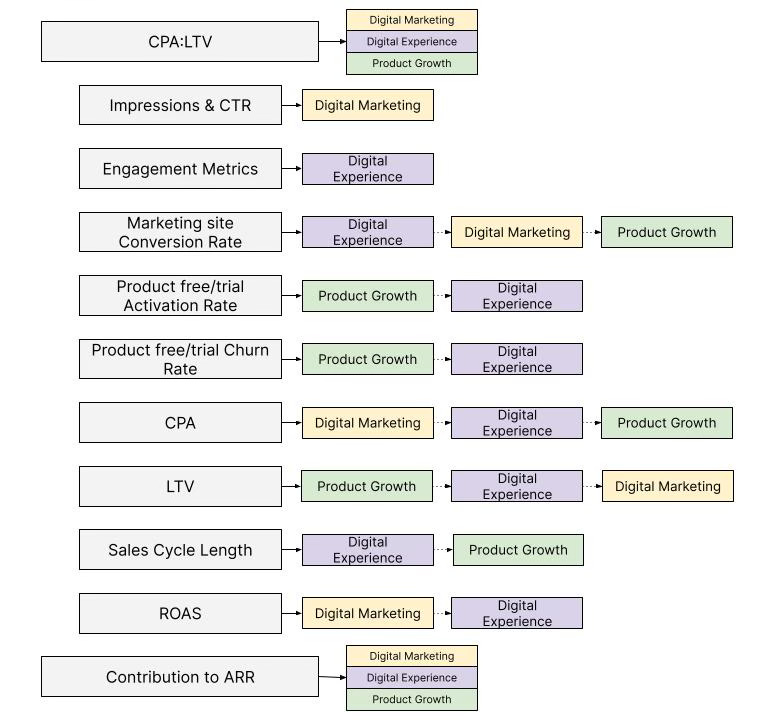
Initiatives: traffic recovery and funnel unification
My default move was a ship and review loop. Agree on the target pages and levers, ship changes weekly, review impact in the scorecard, and cut what didn’t move sessions and conversion.
When the traffic decline became undeniable, I pulled together the cross-functional owners and ran that loop until the trend broke.
In parallel, we unified the funnel. One set of stage definitions across PLG and sales-assisted paths, a short list of conversion moments, and an experiment cadence tied to activation and revenue.
- Revitalized the inbound engine: cross-functional working group, weekly ship/review cadence, and a traffic recovery plan that reversed decline.
- Unified funnel definition and conversion lift: instrumented the end-to-end journey, removed friction, and ran an experiment cadence that compounded learning.
- Lifecycle programs that tied intent to next steps, with clearer stage entry and exit criteria.
Leadership: ownership, cadence, and tradeoffs
I did less "own the channel" work and more "make the system run" work:
- Took over stalled initiatives, reset the cadence, and made ownership explicit.
- Wrote the memos and quarterly plans to get exec sponsorship, DRIs, and shared metrics.
- Protected focus by cutting parallel work and forcing prioritization through quarterly planning.
The tradeoff was focus. We reduced parallel initiatives, prioritized Commercial experimentation, and used quarterly planning to protect execution quality.
What changed: a shared operating loop, clearer tradeoffs, and a more reliable inbound engine.
Results: traffic, conversion, and operating cadence
These outcomes come from the Integrated Growth and Inbound Marketing operating scorecard and quarterly planning reviews from this period. This page is the primary published record of this work.
- Stopped and reversed inbound traffic decline on GitLab’s marketing site.
- Delivered 20% annual growth in site traffic and a 30% increase in site sessions.
- Improved trial conversion by 40% and account sign-ups by 22% after funnel unification.
- Established quarterly planning and a unified To/Through/In PLG motion across Digital Strategy, Digital Experience, and Growth.
- Improved cross-functional coordination and execution quality for Commercial and Enterprise lifecycle programs.
Decision support
FAQ: Fast answers, no filler
The objective, outcomes, and next best path in under a minute.
01What does the GitLab case study cover?
It covers how I rebuilt integrated growth and inbound as an operating unit, including quarterly planning, a shared scorecard, and a unified To/Through/In motion that reversed a traffic decline and improved conversion.
02What was Michael Preuss's role at GitLab?
Senior Manager from Jun 2020 to Feb 2022, then Director of Integrated Growth and Inbound Marketing from Feb 2022 to Aug 2024. Across both roles, I rebuilt inbound and integrated growth, partnered closely with Digital Strategy, Digital Experience, and Growth, and made the system run through cadence, DRIs, and measurement.
03What problem did the integrated growth and inbound system solve?
Inbound and site growth were treated as disconnected initiatives, and priorities churned. The system created one operating loop with quarterly planning, DRIs, and shared measurement.
04What was built in the operating system?
Quarterly plans and OKRs, a shared scorecard, a weekly ship and review cadence, and a unified To/Through/In motion across the teams that owned demand, site experience, and activation.
05What results are documented in this case study?
Stopped and reversed a multi-year traffic decline. Delivered 20% annual growth in site traffic and a 30% increase in site sessions, and established the operating backbone that supported +40% trial conversion and +22% account sign-ups.
06Who is this approach for?
Best for teams rebuilding inbound and integrated growth across multiple functions with shared ownership. Less useful when one team owns the full funnel end to end and coordination cost is low.
07Where should I start if I want the mechanics?
Start with Introduction of X Led Growth. Then Increase Quality Site Traffic. Then Unified Funnel Conversion Lift.